


MSc
MSc Dentistry and Dental Prosthetics (LM-46) – Venice Mestre
Mode
In classCity
Venice MestreLanguage
ItalianAccess
ScheduledCredits
360MSc Dentistry and Dental Prosthetics - Venice Mestre
Venice Mestre
Italian lanaguage
6 years
The MSc in Dentistry and Dental Prosthetics (CLMOPD) is a six-year programme.
The main educational objective is to provide students with the theoretical knowledge and technical skills required to practise Dentistry in accordance with the standards shared by Dentistry schools across the European Union. In particular, all graduates will receive high-quality, excellent training aimed at practising Dentistry at an advanced level, as well as developing skills geared towards various specialisations or related areas of scientific research.
During the first two years, the CLMOPD focuses on the fundamentals of the structural organisation and vital functions of the human body. It also includes courses addressing issues related to the dentist-patient relationship and the principles underlying scientific methodology. The following three years focus on medical, surgical and specialist disciplines, with particular emphasis on clinical issues related to dental diseases, oral semiotics, neuromuscular disorders of the head and neck, and their oral manifestations. Educational activities take place alongside the study of dental disciplines and professional clinical training. The sixth year includes professional training activities aimed at the care of patients with odontostomatological conditions. The scheduled seminar-based lectures are primarily intended to provide opportunities for discussion, from an interdisciplinary and/or in-depth perspective, of topics related to the disciplines included in the Study Plan.
Pursuant to Articles 1 and 3 of Law No. 163 of 8 November 2021, the final examination for the award of the Single-Cycle Master’s Degree in Dentistry and Dental Prosthetics – LM-46 class – qualifies graduates to practise as dentists. For this purpose, the final examination includes a Practical Assessment of Professional Skills (PPV) acquired through a Practical Assessment Internship (TPV) undertaken as part of the degree programme. The PPV is designed to assess the candidate’s level of practical preparation for professional qualification and takes place before the discussion of the final thesis.
Upon completion of the degree programme, graduates will have acquired the knowledge and technical skills required to pursue professional careers in the dental sector, both in the public and private sectors.
Language of instruction: Italian
Chair of the Degree Programme: Prof. Paola Cozza
Academic Manager: Dr Alessia Galati ([email protected])
Career opportunities
Graduates of the MSc.Dentistry and Dental Prosthetics will be eligible to practise as dentists upon passing the final examination and registering with the relevant professional register.
They will be able to practise as dentists in a range of clinical, healthcare and biomedical roles and professional settings within their field of expertise.
They may also pursue first- and second-level managerial positions within the facilities of the Italian National Health Service, following the procedures and requirements established by current legislation.
UniCamillus students also have an inherent international career path, with particular attention to regions of the world where healthcare shortages are most severe and, in many cases, critical. The University encourages applications from young people with a strong humanitarian vocation who may potentially choose to dedicate at least part of their professional lives to serving disadvantaged populations in the Global South.
Teaching methodology
Teaching activities are divided into integrated courses and elective courses.
Integrated courses are the compulsory courses included in the Study Plan. They are formed by combining different courses, including courses belonging to different scientific-disciplinary sectors, in order to achieve a specific common educational objective.
Elective courses are offered exclusively as part of the educational activities chosen by the student and include academic lectures and/or seminars. They provide the cultural background necessary to personalise the student’s curriculum and are aimed at exploring specific areas of knowledge and educational aspects that enhance the graduate’s preparation and training. These objectives are achieved by: responding to the student’s individual interests and inclinations; expanding on topics that are not included in the “core curriculum” of the integrated courses; and promoting a multidisciplinary approach. The range of these educational activities, from which students may make their own individual choice, is organised annually on the basis of proposals submitted by the degree programme’s teaching staff. Elective Educational Activities (ADO) are delivered through interactive teaching methods that encourage students’ active and continuous participation, including lectures, seminars, tutorial activities, elective internships, and clinical and laboratory tutorials.
Types of teaching activities. Within each course, the allocation of University Credits (CFU) and teaching time among the different types of teaching activities is defined as follows:
Ex-cathedra lecture: (hereinafter referred to as a “lecture”) the presentation of a specific topic identified by a title and included in the educational curriculum of the Degree Programme. It is delivered by a lecturer according to a predefined schedule and is addressed to students regularly enrolled in a given year of the programme, who may also be divided into small groups.
Seminar: a teaching activity with the same characteristics as a lecture, but delivered simultaneously by several lecturers, including lecturers from different disciplinary fields (or with different areas of expertise), and, as such, recorded in the official lecture register. Clinical-pathological conferences that may be established as part of clinical courses are also recognised as seminar activities.
Tutorial Teaching (practical sessions): an interactive teaching method addressed to a small number of students. This teaching activity provides knowledge useful for professional practice, primarily through stimuli arising from the analysis of problems, as well as by providing the methodological skills required to solve such problems.
Professional Training Activities: aimed at enabling students to acquire specific professional skills and are carried out in laboratories, simulation rooms and clinics. The compulsory clinical placement is a form of tutorial teaching that requires students to carry out practical activities with progressively increasing levels of autonomy, simulating activities performed in professional practice. At every stage of the compulsory clinical placement, students are required to work under the direct supervision of a tutor-lecturer. The clinical skills acquired through professional training activities are assessed as part of the final examination grade for the course responsible for organising the relevant professional training activities.
Responsibility for the planning and organisation of the clinical placement is assigned to the Academic Manager and the Coordinator of Professional Training Activities. The overall training programme must ensure adequate theoretical preparation and appropriate professional training, including through clinical placements, in compliance with the standards and number of hours established by European Union directives. Training is carried out under the supervision of tutors belonging to the relevant professional profile or to a related scientific-disciplinary sector, with established professional and teaching experience. At the clinical placement sites, service staff are also appointed as contact persons/supervisors who collaborate in the management and delivery of the clinical placement.
Programmed teaching
Programmed teaching include the complete set of courses, the corresponding University Credits (CFU), and the relevant scientific-disciplinary sectors envisaged for the entire degree programme of the reference cohort (year of enrolment).
The Study Plans will be published following accreditation.
Modules offered
Delivered Teaching Activities comprise all courses offered in the relevant academic year, together with the corresponding teaching coverage, including the type and number of hours of teaching to be delivered.
The MSc Dentistry and Dental Prosthetics has a nationally regulated admission process.
Requirements for all applicants, EU and non-EU
Candidates wishing to take the admission test must meet one of the following requirements:
- Hold an upper secondary school diploma obtained after completing a course of study comprising at least 12 years of schooling.
If the diploma was awarded under a foreign education system, the documentation must be accompanied by a Declaration of Value issued by the Italian diplomatic authorities or by a CIMEA Certificate. - Be attending the final year of upper secondary school and be expected to obtain a qualification that is valid for admission to the degree programme (an upper secondary school diploma obtained after at least 12 years of schooling).
The appropriate qualification must be submitted within the specified deadline. Failure to do so will result in the loss of the right to enrol or, if the candidate has already been admitted, in the cancellation of the enrolment. No refund will be provided. - Hold a final upper secondary school qualification obtained within an education system comprising 10 or 11 years of schooling, supplemented by one or two years of university education, provided that all examinations required for those academic years have been successfully completed.
Candidates must also possess the knowledge and skills required in general knowledge, logical reasoning, mathematics, physics, biology and chemistry.
In order to complete their registration for the admission test, each candidate must follow the instructions provided on the dedicated page and pay the relevant admission test fee.
Candidates are responsible for the information provided when completing the registration form. The submission of false, incorrect or omitted information will result in immediate exclusion from the test or, if the test has already been passed, removal from the list of admitted candidates. For all candidates, the admission test fee is non-refundable under any circumstances.
Admissions test
Admission to the Degree Programme is through an admission test.
Candidates who, despite passing the admission test, have not correctly answered at least 60% of the questions in Chemistry, Biology and Physics (i.e. at least six out of ten questions in each subject) will be assigned Additional Educational Requirements (OFA) in the relevant subjects. These students will be admitted with OFA, limited to the subject(s) concerned.
The OFA must be fulfilled by the end of the first year of the degree programme and, in any case, before taking the examination for the course included in the Study Plan that contains the subject requiring remediation.
Class schedules and examination timetables will be published before the start of the academic year on the following pages:


Academic Calendar Academic Year 2026/2027
Venice Mestre campus
The UniCamillus Venice Mestre campus is located at Piazzale San Lorenzo Giustiniani, 11, 30174 Venice, Italy.
The facilities have been designed to meet UniCamillus’ most advanced educational needs. Starting from the end of October 2026, the facility will become operational, offering newly renovated spaces and all the equipment necessary to ensure the optimal delivery of educational activities from the outset.
The project has been conceived with a view to continuous expansion and will progressively grow over time. This evolutionary process will enable the facility to reach its full capacity, providing students with a highly innovative learning environment. At full capacity, the hub will extend over more than 10,000 sqm, including:
- 900 sqm of administrative offices and study rooms;
- 2,300 sqm of teaching rooms;
- 700 sqm of state-of-the-art laboratories and medical simulation facilities;
- 250 sqm of refreshment areas.
Email: [email protected]
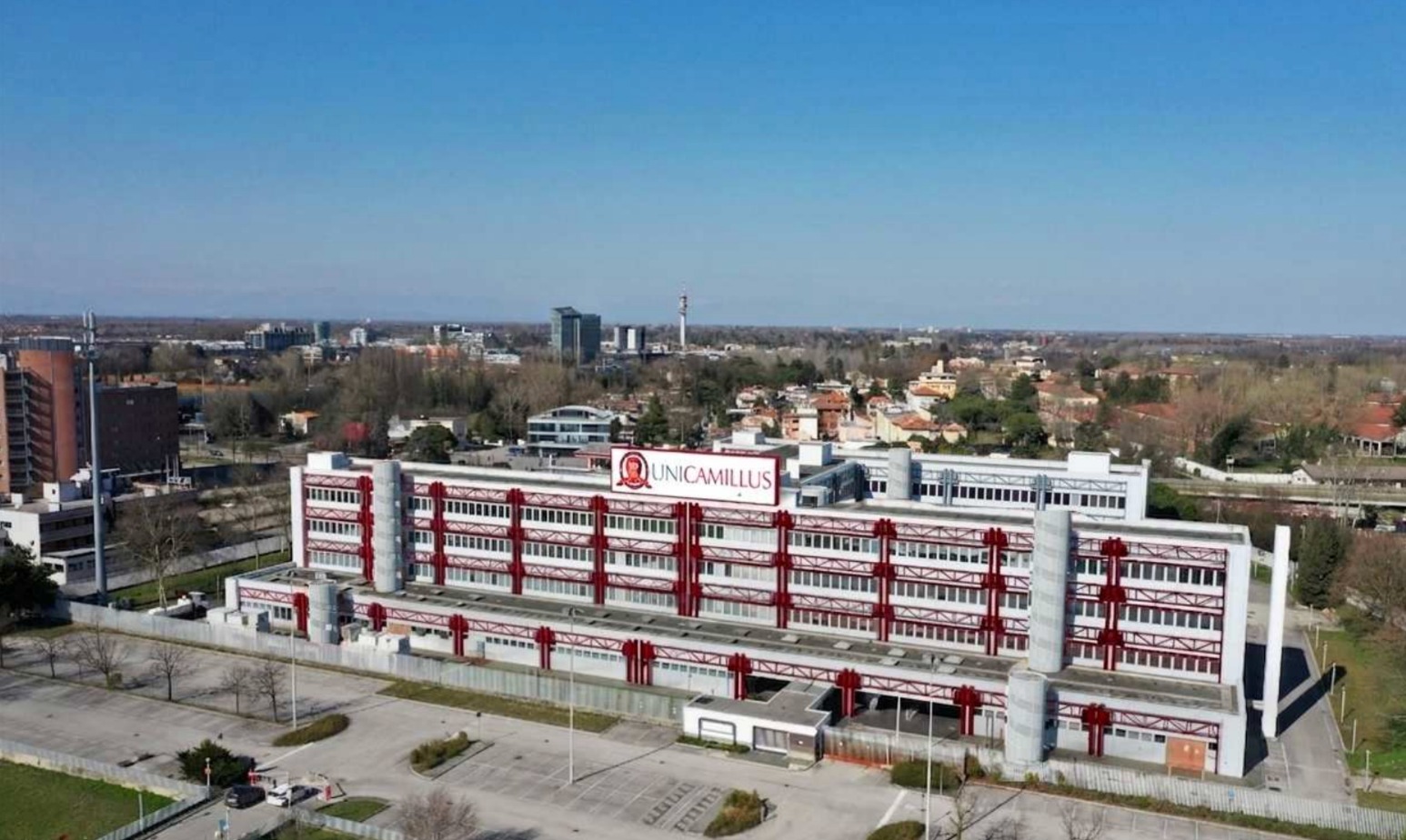 UniCamillus Venice Mestre campus rendering
Contact details and student reports
This service provides UniCamillus students with a means of submitting reports and requests concerning, for example, teaching activities or organisational matters. Its aim is to facilitate appropriate and direct communication between students and the University’s relevant contact persons.
Contacts:
→ For communications with the Academic Manager: [email protected]
→ For communications with the Degree Programme’s Academic Office: [email protected]
The Degree Programme in Dentistry Academic Office is available by telephone during the following hours:
• Tuesday morning, from 9:00 a.m. to 1:00 p.m.
• Wednesday afternoon, from 2:00 p.m. to 5:00 p.m.
• Thursday morning, from 9:00 a.m. to 1:00 p.m.
→ For requests concerning academic career matters: [email protected]
Regulations
⇒ MSc Dentistry and Dental Prosthetics Regulations — academic year 2026-2027 (in Italian)