


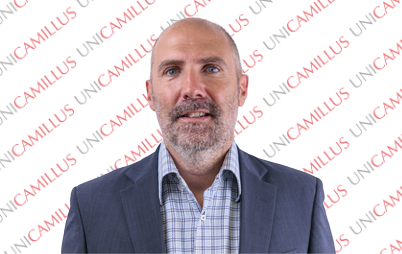
Riccardo Pertile
- MSc Medicine and Surgery (LM-41) – Venice Lido/Mestre
- MSc Dentistry and Dental Prosthetics (LM-46) – Rome
He obtained a degree in Statistical, Demographic and Social Sciences from the University of Padua in 2004 and a PhD in Developmental Medicine and Programming Sciences in 2008 from the same University. During his academic training, he gained study and research experience at Uppsala University (Sweden) and the University of Oulu (Finland), as well as specialized training in epidemiology and biostatistics.
From 2008 to 2010, he conducted research at the University of Verona in the fields of medical statistics and applied epidemiology. From 2010 to 2026, he worked in the Clinical and Evaluative Epidemiology Service of the Trentino Health Authority, where he focused on statistical and epidemiological analysis, health information systems, surveillance systems, observational studies, and healthcare services evaluation.
In 2021, he obtained professional accreditation as a Statistician from the Italian Statistical Society. Since 2022, he has held the Italian National Scientific Qualification (Abilitazione Scientifica Nazionale) for Associate Professor in the academic discipline MEDS-24/A – Medical Statistics. Since 2026, he has been Associate Professor of Medical Statistics at Saint Camillus International University of Health and Medical Sciences (UniCamillus).
Since 2021, he has been Director of the Congenital Anomalies Registry of the Autonomous Province of Trento, accredited within EUROCAT, the European network of population-based registries for the epidemiological surveillance of congenital anomalies. Since 2025, he is also a member of the EUROCAT Variable Validation Committee at the European Commission’s Joint Research Centre. He has participated as principal investigator, co-investigator, or statistical lead in regional, national, and multicentre research projects and is the author of more than 100 scientific publications in national and international journals.
He has been involved in university teaching since 2007, primarily in medical statistics, epidemiology, research methodology, and health data analysis and applied informatics, at the Universities of Padua, Verona, and Trento, as well as in degree programmes for health professions. He has also been involved in postgraduate and continuing professional education.
Main Research Areas
- Maternal, child, and perinatal epidemiology, with particular focus on pregnancy outcomes, preterm birth, maternal and child health, and epidemiological determinants.
- Epidemiological surveillance of congenital anomalies, through population-based registries and national and international surveillance systems, with particular focus on the assessment of prevalence, risk factors, and clinical characteristics of congenital anomalies.
- Real-world data, registries, and health information systems, for population-based epidemiological analyses, the study of healthcare pathways, and the evaluation of healthcare utilization and quality.
- Clinical epidemiology and healthcare intervention evaluation, applying statistical and epidemiological methods to observational studies, clinical research, screening programmes, diagnostic evaluation, and health outcomes research.
- Biostatistics and health research methodology, with particular focus on the application of statistical methods to clinical and epidemiological research and the analysis of complex health data.