


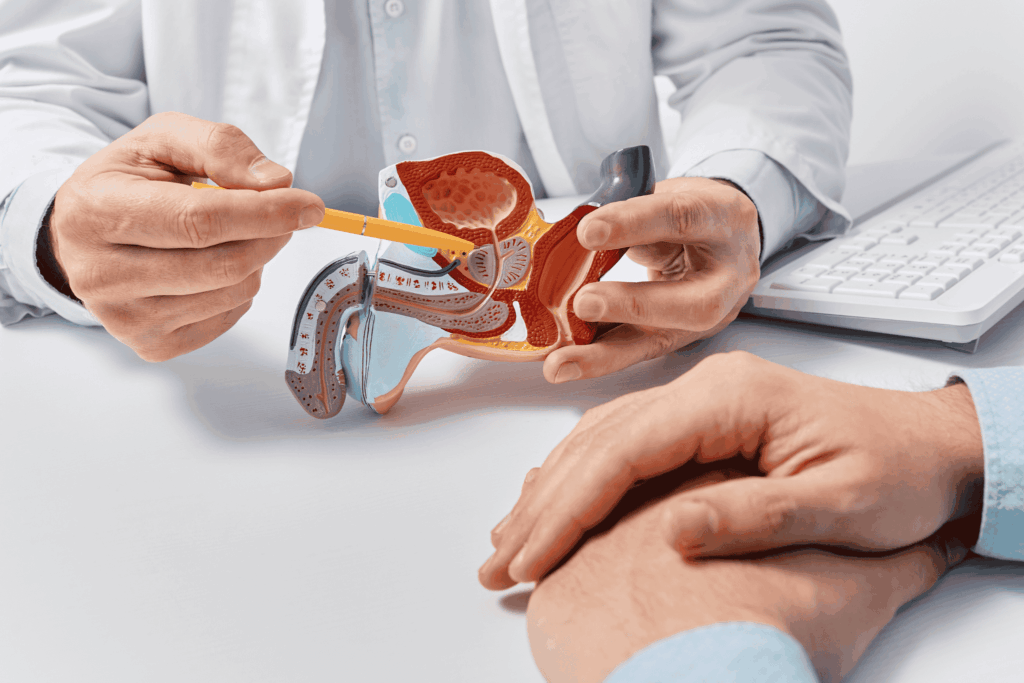
While its complicated name speaks for itself, the adjective ‘benign’ is reassuring. We are talking about benign prostatic hyperplasia (BPH), also known as ‘prostatic adenoma’.
As the name suggests, BPH is the non-cancerous enlargement of the prostate gland, which produces part of the seminal fluid and surrounds the urethral canal through which urine passes. As men age, it is normal for the prostate to grow in size, forming benign nodules that can compress the urethra.
BPH is a very common condition in adult men: worldwide, there were 94 million cases in 2019, compared to 51 million in 2000. Age certainly plays a role, given that around 45% of men over 45 develop BPH, a figure which rises to 80% in men over 70. In Italy, the figures are fairly similar: over six million men aged over 50 are affected. 50% of these men are aged 51–60, 70% are aged 61–70, and the figure reaches 90% in the over-80 age group.
Possible causes
In addition to genetic predisposition, “factors such as a sedentary lifestyle and hormonal imbalances can contribute to prostatic hyperplasia”, says Paolo Emiliozzi, a lecturer in Urology at UniCamillus.
Hormonal imbalances play a central role in the development of benign prostatic hyperplasia, as prostate growth is mainly regulated by androgen hormones, particularly testosterone and its metabolite dihydrotestosterone (DHT). When the balance between androgens and oestrogens is altered, the hyperplasia process can be accelerated.
Genetic predisposition is another important contributing factor: a family history of the condition is therefore considered a genuine risk factor that should not be overlooked.
However, lifestyle also plays a role. Habits such as a sedentary lifestyle, a diet high in animal fats, being overweight, and excessive alcohol consumption tend to increase the risk of developing urinary symptoms associated with BPH. Conversely, although a balanced diet and regular physical activity do not stop prostate growth, they can improve symptoms and contribute to general well-being.
Finally, chronic inflammation of the prostate gland may contribute to the development of BPH. Some studies have shown that persistent inflammation can stimulate the growth of prostate cells and contribute to enlargement of the gland. A recent review published in the International Journal of Urology by Inamura et al. (2024) highlights that chronic inflammation can result from various factors, such as hormonal imbalances, reduced tissue oxygenation (hypoxia), urine reflux into the prostatic ducts, autoimmune responses, and persistent infections. Together, these mechanisms create a pro-inflammatory environment that promotes prostate growth and worsens urinary symptoms in patients.
Common symptoms
The most common symptoms are urinary-related. “Patients wake up at night to go to the toilet, the flow is reduced, and the frequency of urination during the day increases”, explains Emiliozzi. “In addition, there may be an urgent and uncontrollable need to urinate, and the bladder may not empty completely. In fact, at the end of urination, there may be an annoying dribble”. This occurs because an enlarged prostate can obstruct the flow of urine, irritating the bladder muscle (detrusor) and forcing it to exert greater pressure to expel urine despite the prostatic obstruction.
However, it is important to note that these symptoms can also be attributed to other pathological conditions. “Some symptoms caused by obstruction may, in rare cases, be due to other causes”, Emiliozzi explains. “A bladder tumour can irritate the bladder and cause frequent and urgent urination, often accompanied by blood in the urine. The same symptoms may be caused by a stone in the final section of the ureter. A bladder stone can also cause similar irritative symptoms. In all these cases, ultrasound is decisive”.
BPH can have a significant impact on daily life as it is an unpleasant condition. “Frequent night-time urination, frequent daytime urination and the need to rush to the toilet can significantly affect quality of life”, Emiliozzi points out. “In advanced cases, it can lead to renal failure, urinary blockage, recurrent infections or bladder stones—all of which necessarily require surgery”.
Diagnosis: useful tests and evaluation criteria
As our expert states, symptoms alone are not sufficient for diagnosing BPH, as they could be confused with the symptoms of other diseases. For this reason, an accurate clinical evaluation is often sufficient for confirmation: this includes a rectal examination, PSA (prostate-specific antigen) analysis, a urine test and abdominal and pelvic ultrasounds. “Transrectal ultrasound of the prostate is overprescribed and is only necessary in specific cases. When the diagnosis is unclear, selected patients may require a urodynamic examination to provide information on bladder capacity, sensitivity, and urinary pressures”, adds Emiliozzi.
Available treatments
BPH is a chronic condition, but it can be managed using various strategies. The first step is pharmacological treatment. “The most commonly used medicines are alpha-lytics, which widen the calibre of the intraprostatic urethral canal. Side effects may include a drop in blood pressure and retrograde ejaculation (i.e. semen does not come out at the moment of climax)”, explains Paolo Emiliozzi, a lecturer in Urology at UniCamillus. “Other medications, such as finasteride and dutasteride, reduce prostate volume by 15–20%. In a small percentage of cases, they can cause erectile dysfunction. Some herbal remedies, such as Serenoa repens, can alleviate symptoms. Finally, it has recently been discovered that one of the most effective drugs for erectile dysfunction, tadalafil, administered in small doses every day, can improve symptoms”.
When symptoms do not respond to medical therapy, minimally invasive surgery may be used. “In most cases, the adenoma is removed transurethrally, using a fibre optic instrument inserted into the urethral canal that uses a micro-scalpel or laser to remove the obstruction”, continues Emiliozzi. “In high-risk patients, there are even less invasive treatments available, such as the use of an intraprostatic water or steam jet, the use of mini-prostheses in the urethral canal, or the heating of prostate tissue. Another possibility is endovascular closure of the arteries that supply the prostate”.
For very large prostates, the expert points out that adenoma enucleation with a laser can be used, followed by reduction into fragments inside the bladder, or robotic surgery to remove the adenoma through small holes in the abdomen.
Benign prostatic hyperplasia is therefore a fairly common condition in men as they age. This does not mean that it should be normalised and underestimated: precisely because there are many personalised treatments available to keep it under control, it is important to consult an expert in the field to start an appropriate course of treatment as soon as possible. As always, early diagnosis improves quality of life and prevents unnecessary and insidious deterioration.
Paolo Emiliozzi is a lecturer in Urology in the third year of the English-taught MSc in Medicine and Surgery at UniCamillus, Rome Campus.