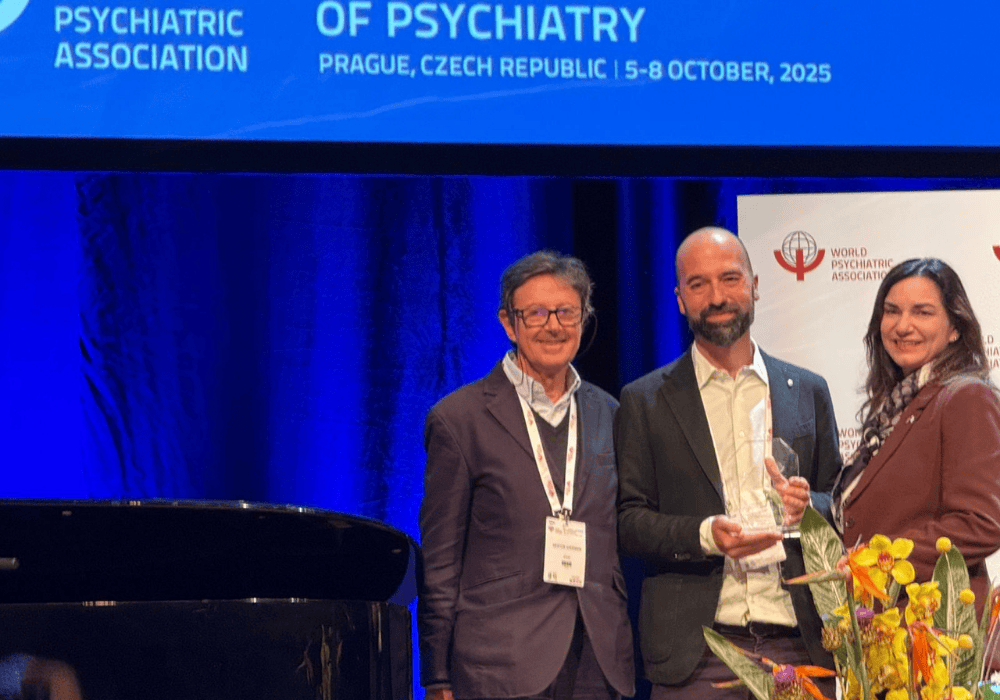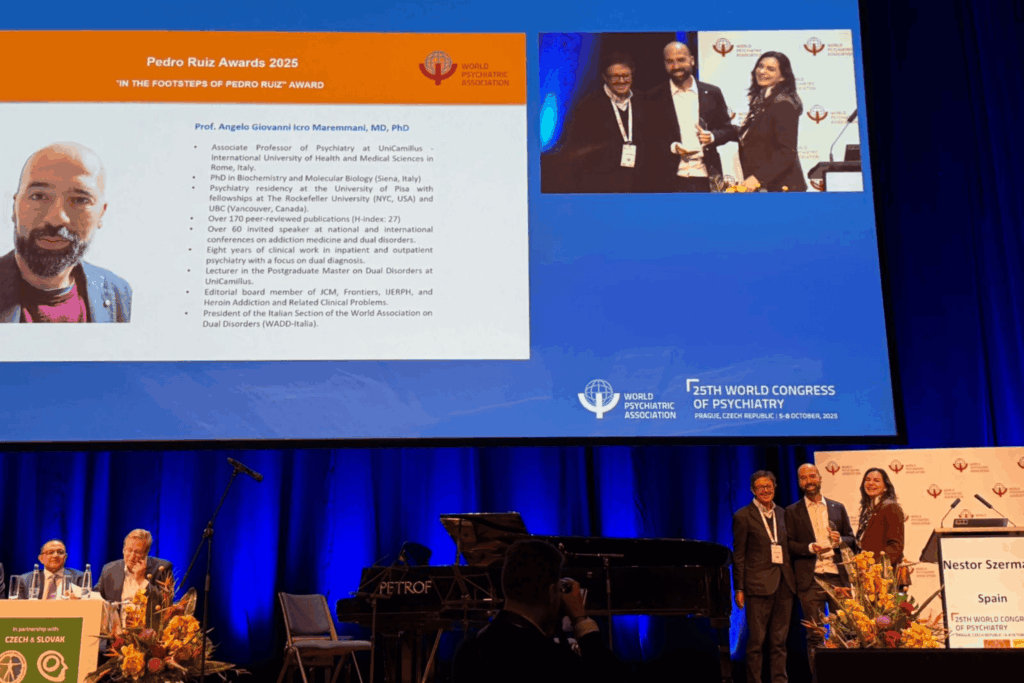
There comes a moment in a lecturer’s professional life that goes beyond academic recognition or personal gratification: it is when one’s work is seen, understood and appreciated by colleagues from around the world. For Professor Angelo Giovanni Icro Maremmani, Associate Professor of Psychiatry at UniCamillus, that moment came in Prague, during the opening ceremony of the 25th World Congress of Psychiatry—organised by the World Psychiatric Association—where he received the ‘In the Footsteps of Pedro Ruiz’ award.
This is an international honour awarded to young psychiatrists who have distinguished themselves in the treatment of dual disorders: complex conditions in which a psychiatric illness is intertwined with a substance use disorder, creating incredible clinical, relational and human challenges. It is not about treating two separate problems, but about understanding a person in their full complexity—their fragility, suffering and resilience.
The award, dedicated to Professor Pedro Ruiz—founder of the World Association on Dual Disorders (WADD) and an international reference point in psychiatry—embodies not only scientific excellence, but also a humanistic vision of care: Ruiz showed the world that psychiatry is not only about diagnoses and protocols, but also about empathy, listening, and a holistic view of the person.
Receiving this award means entering a tradition that combines scientific rigour with deep patient care—a synergy of science and humanity that we know well at UniCamillus, thanks to the teachings of Saint Camillus De Lellis.
For Professor Maremmani, the award reflects years of dedicated work across research, education and clinical practice. It is a commitment to giving voice to those suffering from dual disorders and to finding effective, personalised therapeutic pathways.
In this interview, Professor Maremmani shares the emotions tied to this prestigious honour, explains what it truly means to treat dual disorders, and reflects on the moments that have shaped his journey. It is a story that speaks of science—but above all, of people, of listening, and of a passion for a discipline that, day after day, seeks to turn care into a true act of humanity.
What did you feel upon receiving the ‘In the Footsteps of Pedro Ruiz’ award at the World Congress of Psychiatry in Prague?
“It was an incredibly intense emotion. This award is dedicated to physicians under the age of 45 who have distinguished themselves in the field of psychiatry, and receiving it during the opening ceremony of the World Congress of Psychiatry, in front of colleagues from all over the world, was a moment that will stay with me forever. Professor Pedro Ruiz was an international reference point—not only for his scientific contributions, but also for his humanistic vision of psychiatry. He remains a source of inspiration for those, like myself, who strive to integrate the biological, psychological and social aspects in patient care”.
What exactly is a ‘dual disorder’?
“The term ‘dual disorder’ refers to the coexistence of a psychiatric condition and a substance use disorder. It is not simply the sum of two diagnoses, but a unique condition in which psychiatric symptoms and those related to substance use are deeply intertwined, influencing one another and following a single evolutionary progression. It is one of the greatest challenges in modern psychiatry, given its extremely high prevalence—up to 70% of patients with severe psychiatric disorders also struggle with problematic substance use. This calls for an integrated therapeutic approach, capable of addressing both dimensions simultaneously—mental health and addiction—overcoming the traditional separation between the two fields”.
What are the main challenges still faced in recognising and effectively treating these disorders?
“The main difficulties concern, first and foremost, the organisation of clinical settings. Even today, in Italy as in many other countries, mental health and addiction are managed in separate domains: on one side, mental health centres dealing with psychiatric disorders; on the other, addiction services dedicated to substance use disorders. This administrative and clinical division does not reflect the reality of patients, who often present both conditions in an intertwined way. As a result, many risk not receiving truly integrated treatment. To effectively address dual disorder, it is essential to promote structured collaboration between the two systems, as well as shared training: psychiatrists working in different settings must have a common language and cross-disciplinary skills, in order to build therapeutic pathways centred on the person—not on the dominant diagnosis”.
It is not a particularly well-known disorder, at least among the general public. Is this lack of awareness unique to Italy? How does Italy compare internationally in the clinical management of this condition?
“In several countries, Addiction Medicine has become an established academic field, aimed at equipping future physicians and psychiatrists with the skills needed to manage dual disorder through an integrated approach. Unfortunately, in Italy this specialty is not yet recognised as an independent academic field, and this results in a lack of specific and consistent training nationwide. As a consequence, many professionals find themselves dealing with complex disorders without adequate neurobiological and clinical preparation to understand the interaction between mental illness and substance use. This is a significant gap, because dual disorder has become one of the most frequent challenges in psychiatric practice. Bridging this educational and cultural divide would mean aligning Italy with international standards and offering patients more effective care pathways, consistent with scientific evidence”.
What are the future prospects for research and treatment? And what are your personal research goals in this area?
“The challenge ahead will be to train an increasing number of mental health professionals with foundational skills in Addiction Medicine. It is essential that psychiatrists and addiction specialists share a common language and an integrated vision, so that dual disorder can be understood and treated as a single complex condition—not as the sum of two separate pathologies. Unfortunately, at university level, structured training programmes are still lacking within MSc programmes and psychiatry specialisation programmes. That’s precisely why, in our own small way, we try to fill this gap by launching initiatives dedicated to training young colleagues. One example is the CPD second-level course in Addiction Medicine at UniCamillus—a programme that, year after year, attracts growing interest, reflecting the need to acquire practical tools to address the complex needs of patients with dual disorders in clinical practice. From a research perspective, my work continues to focus on studying the interactions between psychiatric disorders and substance use, with particular attention to neurobiological mechanisms and clinical evolutionary progression that may guide us toward more targeted and effective treatments”.
You received this award for your work in treating this disorder. Could you briefly summarise your approach?
“My approach stems from a clinical and research interest I’ve nurtured since my specialisation, focused on so-called ‘special’ populations, in which substance use and psychopathology intertwine to form a unique clinical picture. I’ve always been fascinated by how the long-term effects of substance abuse overlap with core psychopathological constructs, altering their clinical expression. I believe it is essential to start with an accurate diagnosis and a comprehensive understanding of the person, then build a therapeutic course that follows a sequential and integrated logic. Often, the first step is to stabilise the disorder that most affects the patient’s life, and then address the other aspects in a coherent way. A typical example is a patient with bipolar disorder and cocaine abuse: treating mood instability and addiction separately is ineffective, because cocaine itself acts as a powerful mood destabiliser. In these cases, a holistic approach—one that integrates psychiatric and addiction medicine expertise—becomes the key to achieving real and lasting clinical outcomes”.
Is there a single therapeutic course for treating dual disorder, or does it depend on the individual?
“It’s a very complex question, because there is no single therapeutic course that works for everyone. Each person with a dual disorder is a unique clinical case, with their own clinical history, level of awareness and motivation for change. Generally speaking, treatment involves two distinct professional teams: on one side, the psychiatrist working in mental health services; on the other, the specialist operating within addiction services. This separation reflects the current organisation of the healthcare system, but it often fails to meet the real needs of the patient—who would instead benefit from a unified and coordinated intervention. Another crucial aspect is the patient’s awareness of their condition: many individuals with dual disorder do not fully perceive the need for treatment, especially in the early stages. Only over time, as the condition worsens and increasingly interferes with daily life, people become more willing to engage in structured care. That’s why building a therapeutic alliance and personalising the treatment remain central elements for achieving lasting results”.
Which aspect of your work do you believe led to this recognition?
“I believe a key factor was the continuity with which I’ve dedicated myself—since my postgraduate training—to the study and treatment of substance-related disorders and dual disorder. Having had the opportunity to work closely with so many patients has allowed me to understand, together with them, clinical and behavioural dynamics that often escape theoretical observation. The clinical component—the everyday practice—has always been the heart of my work. That’s where the most authentic research questions are raised. At the same time, this award is not just personal—it represents the result of the work of an entire research group with whom I’ve shared, and continue to share, this journey. Without ongoing collaboration and exchange with colleagues, none of this would have been possible”.
Why have you devoted so much of your work to this disorder? Could you share an anecdote, a moment or a discovery that marked a turning point for you?
“From the very beginning of my clinical career, I felt a strong interest in these patients—often labelled as ‘difficult’ or ‘uncooperative’. Indeed, behind this complexity lies profound suffering and a rich human condition that deserve listening and understanding. I remember that, early in my experience, I would always ask patients why they had started using substances. Many replied, with great sincerity, that they did it simply for the pleasure it gave them. That answer—seemingly simple—struck me deeply. It made me realise that substance use behaviour was not merely a voluntary or moral act, but the expression of a disruption in deep neurobiological circuits, linked to the reward system and neuroplasticity. From that moment on, I felt the need to study substance use disorder and dual disorder as true brain diseases, with clinical and pathophysiological dignity equal to any other medical condition, such as diabetes or cardiovascular disease. That awareness was the turning point for me, and it has guided my entire journey in research and care ever since.”
Speaking of the academic context: how can the university environment help raise awareness of complex issues like dual disorder?
“Today, in the national scientific landscape, there are societies that focus primarily on psychiatry and others that concentrate on addiction—but there is still a lack of real integration between these two areas. Academically, we should commit to recognising dual disorder as an autonomous field of study, capable of bringing together skills and perspectives rather than keeping them separate. In this sense, the role of universities is crucial: they can promote culture, education and research on a topic that, despite its significant clinical and social impact, is still underrepresented in academic curricula. I am particularly proud to chair the Italian section of the World Association on Dual Disorders (WADD-Italia), which represents the national network of an international group dedicated to spreading scientific knowledge and promoting good clinical practices in this field. Looking ahead, I hope that in the next ten years Italian universities will be able to dedicate a specific and stable space to the study of dual disorder—offering all future physicians, both specialists and general practitioners, a shared vocabulary and basic tools to recognise and address this complex condition. General practitioners are often the first to come into contact with these patients and must be equipped with adequate training to guide them toward appropriate courses of care”.
Professor Angelo Giovanni Icro Maremmani teaches Psychiatry in the fourth year of the MSc Dentistry and Dental Prosthetics and in the second year of the BSc Physiotherapy at UniCamillus University. Since the academic year 2022–2023, he has also been a lecturer in the CPD second-level course in Addiction Medicine at UniCamillus University.