


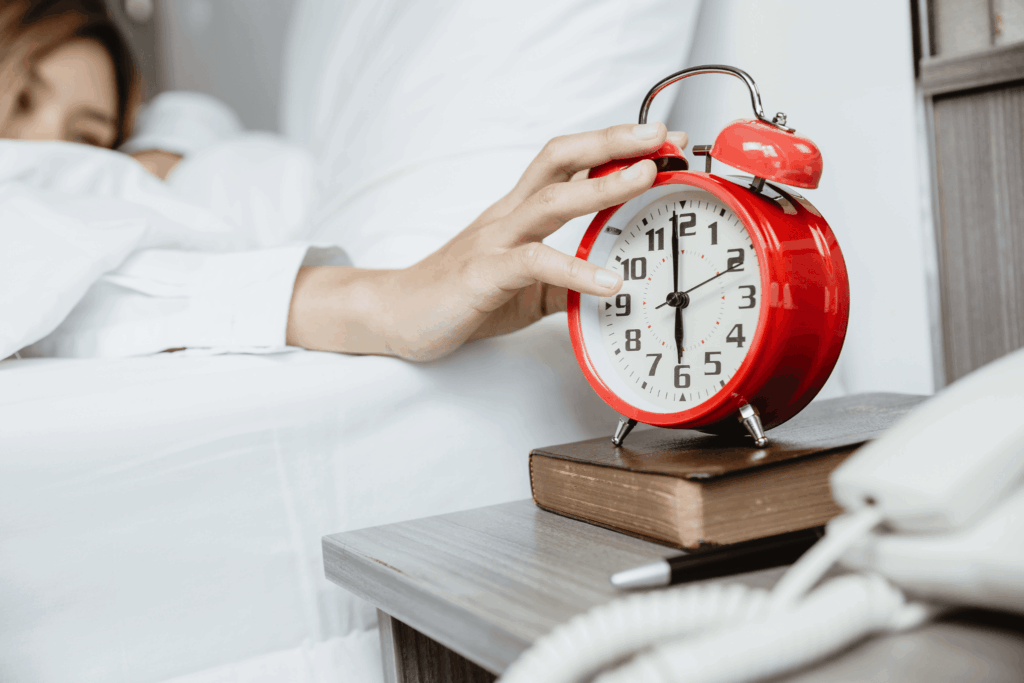
Last weekend, we enjoyed an extra hour of sleep. But are we really feeling more rested? Probably, but not necessarily. In some cases, adapting to the time change can lead to several days of fatigue and disorientation, even when it gets dark earlier. Those who are ‘early birds’—i.e. people who tend to wake up early and are more active in the morning—generally find it more difficult to adapt to the time change than ‘night owls’—i.e. people who perform better in the evening and find it hard to wake up early. Of course, this isn’t a universal rule! But let’s take it one step at a time: what is the time change, and why do we have it?
Switching from standard time to daylight saving time (DST) is a practice adopted by over 70 countries to optimise evening daylight. Although it is well established, it continues to divide scientists and politicians. While it was originally introduced to save energy, scientific evidence now calls into question its benefits and highlights its potential health consequences.
These consequences were analysed in a systematic review conducted by Professor Andrea Romigi‘s team. Professor Romigi is a lecturer in neurology at UniCamillus University and head of the Sleep Medicine Centre at IRCCS Neuromed. Published in Sleep Medicine Reviews, the review analysed 27 studies conducted over the last 43 years to assess the impact of time changes on sleep duration and quality, daytime sleepiness, and circadian rhythms.
43 years of research on time changes
Time changes were analysed in studies covering a span of 45 years. The researchers followed the PRISMA 2020 guidelines—an international standard that helps compile systematic reviews and meta-analyses transparently, comprehensively and reproducibly—and selected studies conducted between 1980 and 2023 including participants aged 6 to 85 years. Both objective and subjective assessments were considered.
These include actigraphy (a non-invasive technique that measures and records body movements over time to analyse sleep-wake rhythms), vigilance tests (used to assess attention, alertness, and reflexes), and hormone level monitoring.
Subjective assessments include the Pittsburgh Sleep Quality Index (PSQI)—a questionnaire that evaluates sleep quality—as well as sleep diaries and sleepiness scales.
Overall, the examined studies cover Europe, the Americas, and Australia, and include a wide variety of ages, chronotypes, and lifestyles.
Key finding: standard time is less disruptive
There are two types of clock change: spring and autumn transitions.
The spring shift to daylight saving time is the most critical: almost all studies report a reduction in sleep duration and a decline in sleep quality. Additionally, daytime sleepiness increases, particularly among individuals with an evening chronotype (‘night owls’), who find it more difficult to adjust their rhythm.Conversely, morning chronotypes adapt more easily, with minimal or no effects. Some studies also report an increase in workplace accidents and reduced alertness in the days immediately following the change.
The transition to standard time in autumn is much less complicated for the body. The effects are milder and can even be beneficial: some studies have shown an increase in sleep, as well as improvements in mood and morning performance. However, there are reports of temporary disturbances, such as insomnia and fragmented sleep, due to the body’s adaptation to the new time.
The less disruptive nature of standard time is also evident in studies on permanent time models, i.e. countries that have experimented with either permanent daylight saving time (pDST) or permanent standard time (pST).
With permanent daylight saving time (pDST), the misalignment between biological and social clocks increases, resulting in greater social jet lag (affecting up to 16% of people with a difference of more than two hours) and a worsening of winter mood.
Permanent standard time (pST), on the other hand, is more in sync with natural circadian rhythms, ensuring better sleep quality and reduced daytime sleepiness.
Studies that have measured physiological parameters such as melatonin, cortisol and body temperature also confirm this theory, indicating that the human body remains anchored to the solar rhythm and adapts only partially to the imposed time change.
Therefore, the review conducted by Professor Romigi’s team shows that the effects of switching to daylight saving time are modest but recurrent, and even if temporary, they can impact well-being, alertness and safety. For this reason, adopting permanent standard time would be more consistent with human biology.
The authors encourage reflection on public policies that better respect circadian rhythms, avoiding seasonal shifts that—though brief—represent a real ‘mini social jet lag’.