


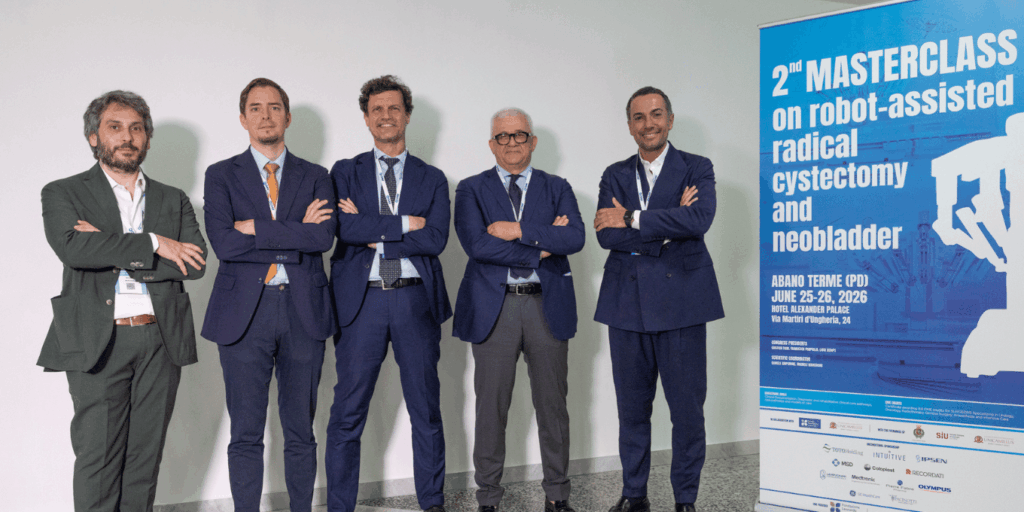
In Italy, there are approximately 30,000 new diagnoses of bladder cancer each year. Around 5–10% of patients—referring to the most severe cases, such as when the tumor invades the bladder muscle—are eligible for robot-assisted radical cystectomy with reconstruction of a new bladder. Today, this represents one of the most complex and advanced procedures in urologic surgery.
This is the focus of the scientific event “2nd Masterclass on robot-assisted radical cystectomy and neobladder,” taking place today and tomorrow in Abano Terme (Padua, Italy) at the Hotel Alexander Palace (Via Martiri d’Ungheria 24). The meeting will bring together leading Italian experts in the field to explore surgical techniques, including live surgery sessions broadcast from the University Hospital of Padua, the Campus Bio-Medico University of Rome, and the IRCCS Candiolo Cancer Institute.
The training event is organized by the Leonardo Hospital Group and UniCamillus University – Saint Camillus International University of Health and Medical Sciences, with coordination by Over and with the support, as educational provider, of the Leonardo Foundation for Medical Sciences. The Masterclass has received the patronage of the Municipality of Abano Terme, the Italian Society of Urology (SIU), and the university itself, and will host 150 participants.
The revolution of “tailor-made” robotic surgery
Scientific and technological progress has today shifted the boundaries toward increasingly minimally invasive and personalized procedures. “Although conservative surgery is the approach used in most cases, for the subset of patients—estimated at between 1,500 and 3,000 per year—who require radical removal of the organ and its reconstruction, next-generation robotics is rewriting the rules of care. It is no longer merely a life-saving procedure, but an extremely precise surgical act which, thanks to the synergy between minimally invasive robotics and enhanced recovery protocols, transforms a highly complex operation into a treatment pathway capable of restoring patients’ quality of life in half the time,” emphasizes Professor Luigi Schips, Director of the School of Specialization in Urology at UniCamillus University, established at the Abano Polyclinic.
On the occasion of the Masterclass, the urological community comes together for an unprecedented moment of discussion on procedures involving bladder replacement (cystectomy) through the reconstruction of a new bladder using a segment of intestine—an orthotopic neobladder—comparing global surgical standards such as the Studer and Hautmann techniques with more recent developments, including the VIP methods (Padua Ileal Bladder), the Florin technique, and the French school of Bordeaux.
Robotic surgery: a tailor-made approach for each patient
Today, radical cystectomy is no longer a standardized procedure. “It has now become a surgical practice ‘tailored’ to each individual patient. The integration of precision robotic surgery with the most advanced technologies, such as Single-Port access through a single umbilical entry point, allows for minimized invasiveness while ensuring increasingly high oncological and functional outcomes,” adds Professor Schips.
Multidisciplinary approach and the ERAS protocol
At the Masterclass, experts highlighted another step forward in quality, which does not rely solely on technology but on the synergy of a multidisciplinary team combining targeted oncological therapies with modern enhanced recovery protocols (ERAS – Enhanced Recovery After Surgery).
“This combination of high-tech surgery and integrated medical management makes it possible to significantly reduce historically long hospital stays, allowing patients to safely return home in just 7–10 days,” the professor specifies.
Superficial and invasive bladder cancer
Bladder cancer is one of the most common malignancies in our country. Its distribution by sex is markedly unbalanced, with a 4:1 ratio in favor of men: approximately 25,000 new cases per year in men compared to 5,000–6,000 in women. This gap is historically linked to higher occupational exposure to risk factors and to smoking prevalence among men.
The vast majority of patients (75–80%) present with superficial forms that can be treated without organ removal, using minimally invasive procedures and outpatient intravesical instillations of chemotherapy or immunotherapy drugs, which treat non–muscle-invasive (superficial) tumors and reduce the risk of recurrence and progression after surgical removal (TURV – transurethral resection of the bladder).
“In cases of more severe muscle-invasive disease, a strict selection of patients eligible for the procedure is required: the tumor must not involve the bladder neck or the urethra, because the neobladder is ‘connected’ where the original bladder was located to allow natural urinary flow. Other criteria include the absence of metastases and the patient’s ability to manage postoperative rehabilitation. It is essential that these patients are treated in high-specialization, high-volume centers capable of ensuring the necessary standards of safety and precision,” specifies Schips.
In other cases, a urinary diversion is performed, in which urine continuously drains into an external bag.
Robotic surgery advantages and surgical techniques
Technology offers new opportunities for these patients. “Robotics,” emphasizes Professor Schips, “provides the surgeon with 3D HD vision and articulated instruments that allow millimetric precision in isolating lymph nodes and preserving the nerves responsible for continence and sexual function. Patients benefit from reduced pain, minimal blood loss, and faster recovery of intestinal function. This minimally invasive approach has further evolved with da Vinci Single Port technology, which enables both removal and reconstruction through a single umbilical access of just 3–4 centimeters, further reducing abdominal trauma, eliminating the risk of wound infection, and ensuring optimal aesthetic results with an almost invisible scar.”
A personalized choice
The difference between techniques lies in the shape given to the segment of intestine removed from the patient and used to create the new bladder: a “chimney” shape in the Studer technique to protect the kidneys, a “W” shape in the Hautmann technique for greater capacity, a spherical configuration in the Padua technique to reduce robotic suturing, and an anatomical design in the French Florin and Bordeaux approaches to preserve blood vessels.
“The final choice is always personalized. The surgeon evaluates whether the tumor does not involve the urethra in order to ensure natural urination, the good health of the intestinal segment to be reshaped, adequate kidney function to avoid metabolic imbalances, and the patient’s strong motivation, which is essential to face postoperative muscular rehabilitation,” explains the urologist.
Differences between men and women
The procedure presents different challenges depending on gender. “In men,” concludes the professor, “the priority is to isolate the nerve bundles in order to preserve erectile function and the sphincter for continence. In women, the operation is anatomically more extensive, as it often involves the uterus and the vaginal wall, requiring a complex reconstruction of pelvic support structures to prevent neobladder prolapse and to ensure proper sexual and urinary function.”