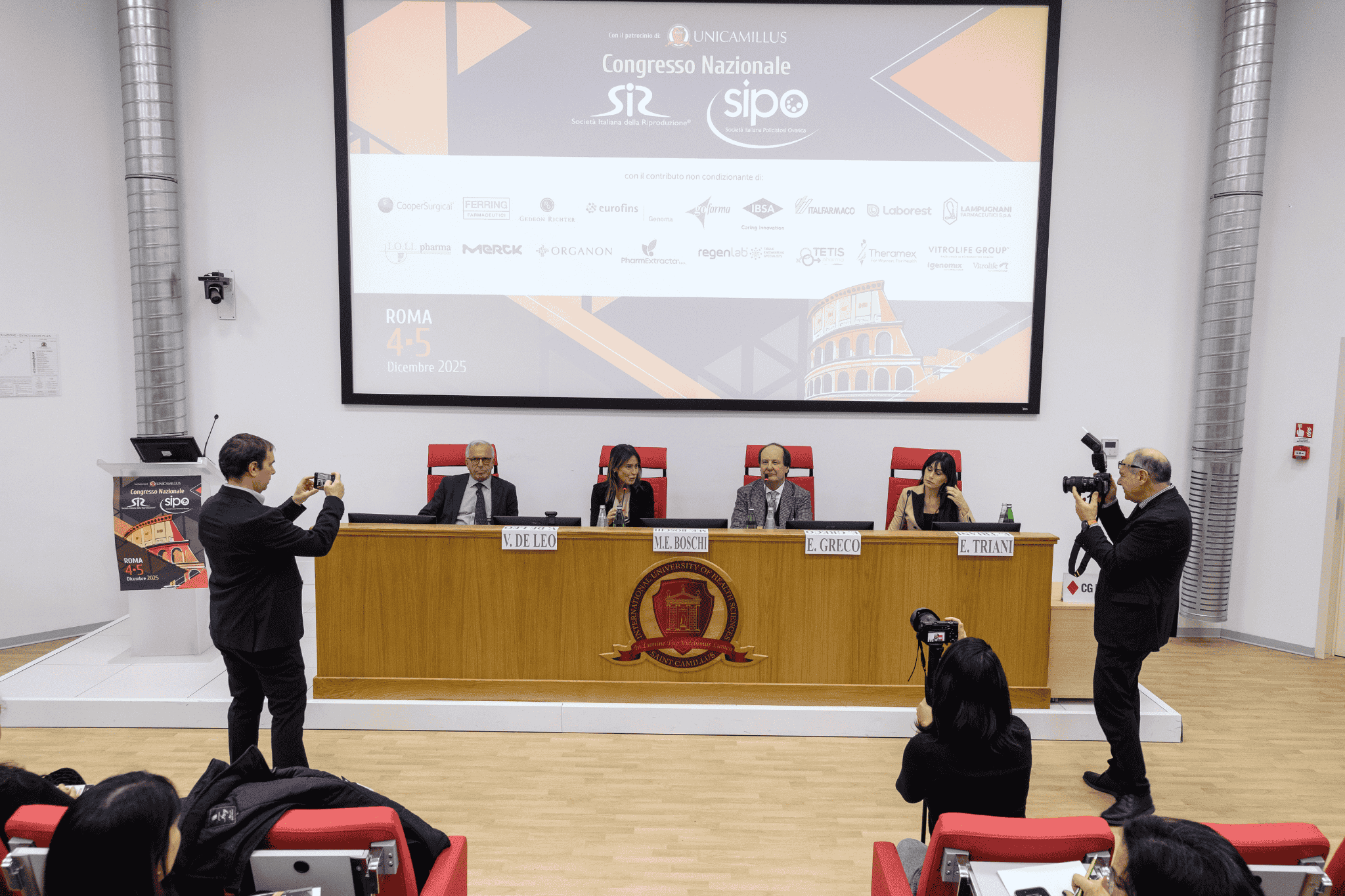
As in previous years, the Rome campus of UniCamillus hosted the National Congress of the Italian Society of Reproduction (S.I.d.R.) and the Italian Society of Polycystic Ovary Syndrome (SIPO). Focusing on Assisted Reproductive Technology (ART), the event took place on 4 –5 December 2025 and was once again organised by Dr Ermanno Greco, a leading specialist in this field, as well as President of S.I.d.R. and a lecturer in Gynaecology and Obstetrics at UniCamillus.
Fertility in Italy: demographic context
The debate took place against the backdrop of a challenging historical and social context for Italy. According to the latest Istat data, only 369,944 children were born in 2024, marking a 2.6% decrease compared to the previous year. Furthermore, the average number of children per woman reached a historic low of 1.18. The average age of mothers at the birth of their first child increased to 31.9 years, almost four years older than in 1995. Infertility now affects around 15% of couples.
There are many causes, which are often intertwined. Some depend on personal choices, such as postponing pregnancy for economic or work reasons. Others depend on biological conditions, such as ovulation and gynaecological disorders in women, or sperm quality and overall health in men. In this context, ART offers a viable solution for many couples. In Italy, the number of births resulting from assisted reproductive techniques increased from 63,585 in 2005 to 109,755 in 2022, representing a 72.6% increase. This equates to 4.3% of all births in Italy in the same year.
Among those who resort to ART, the causes of infertility are diverse: 19.9% of cases are male-related, 43.3% female-related and 16.9% involve both partners. These figures reflect biological factors, lifestyles, and cultural choices, revealing a complex, shared phenomenon requiring medical intervention and social support. It is precisely these scientific advances and medical perspectives that the S.I.d.R. and SIPO Congress at UniCamillus aims to highlight.
The main topics of the conference
In addition to Dr Ermanno Greco, MP Maria Elena Boschi also introduced the conference and officially opened the event. For the next two days, some of the field’s leading experts took the stage, guided by journalist Elisa Triani.
One of the main topics was heterologous fertilisation—an assisted reproduction technique that enables infertile couples to conceive using donated gametes when their own are unavailable or unsuitable. Ovarian stimulation was also discussed, referring to medical protocols designed to help women produce more oocytes during a cycle, thereby increasing the success rate of ART treatments. Another central focus was pre-implantation genetics: an innovative tool that allows embryos to be analysed before transfer to the uterus. This makes it possible to select chromosomally healthy embryos, reducing the risk of implantation failure or genetic disease.
“Pre-implantation genetic testing can have a significant impact on pregnancy rates, personalised treatment and reproductive safety. Modern embryo selection tools can also significantly improve the success of in vitro fertilisation techniques, especially for women over 35. This situation is becoming increasingly common in ART centres, where the average female patient is 38 years old—an age at which chromosomal abnormalities in oocytes are physiologically more prevalent”, observed Dr Ermanno Greco.
The conference also featured in-depth discussions on common yet frequently overlooked female conditions such as endometriosis—a disorder in which tissue similar to that of the uterus grows outside the organ, causing pain and often making conception difficult. In addition to ART, the conference considered other aspects of reproductive and general health, such as contraception, to enable informed choices about pregnancy, as well as metabolic disorders such as obesity and diabetes, which affect fertility and pregnancy outcomes. Finally, the use of antiandrogens was discussed. These medicines can help to treat conditions such as polycystic ovary syndrome (PCOS), which impairs ovulation and female hormone regulation. The conference also emphasised the importance of providing couples with honest information and ensuring equal access, while avoiding unrealistic expectations.
Institutions and universities: towards expertise and understanding
From an institutional point of view, Maria Elena Boschi emphasised the importance of such conferences. “These two days provide a valuable opportunity for high-level scientific discussion on a topic that is central to our country”, said the MP. “Italy is experiencing a profound birth rate crisis. The average age at which people have children continues to rise and often it is too late to address infertility, which affects an increasing number of couples. Greater awareness of risk factors is needed, from lifestyles to diseases that affect fertility. We heard important contributions on how institutions can promote broader information for both men and women—not only on infertility, but also on the techniques available to overcome it. It is also essential to support couples with psychological and emotional care. From a legislative perspective, we must provide effective measures, such as supporting women who choose oocyte cryopreservation, even when they lack the financial means to do so”.
“Hosting the S.I.d.R.-SIPO Congress at UniCamillus, masterfully promoted by Dr Ermanno Greco, means highlighting issues that profoundly affect many couples: fertility, waiting, fear of failure, and the desire to become parents”, said Gianni Profita, Rector of UniCamillus. “These are human aspects that deserve to be heard, respected and addressed with competence. That is why I am proud that, for two days, our university will be a place where science serves hope, and top-level professionals come together to share knowledge and unite in finding answers to problems that are not only clinical, but also emotional and social. It is in the ability to understand and accompany vulnerability that medicine expresses its most authentic value”.
Gallery