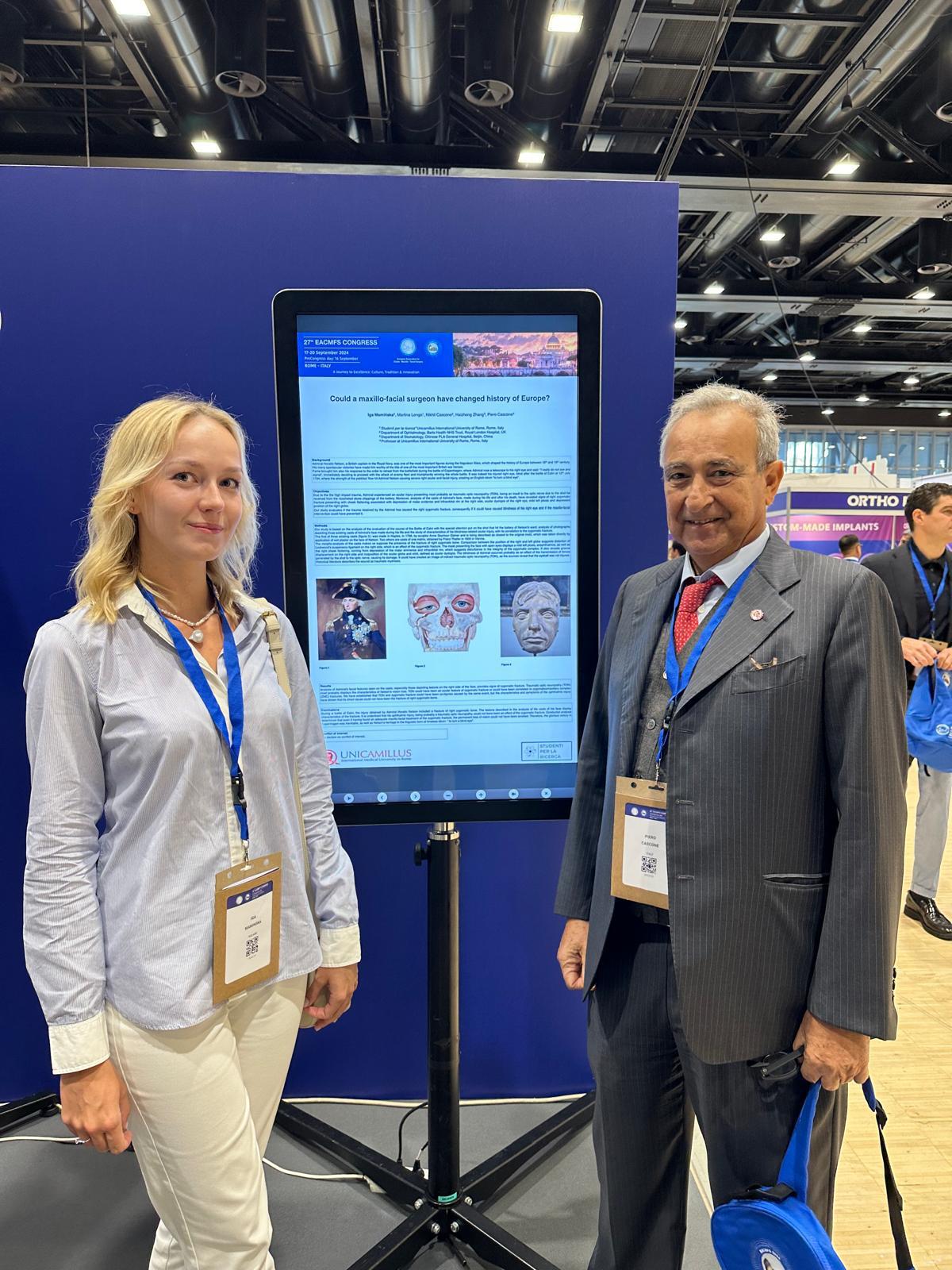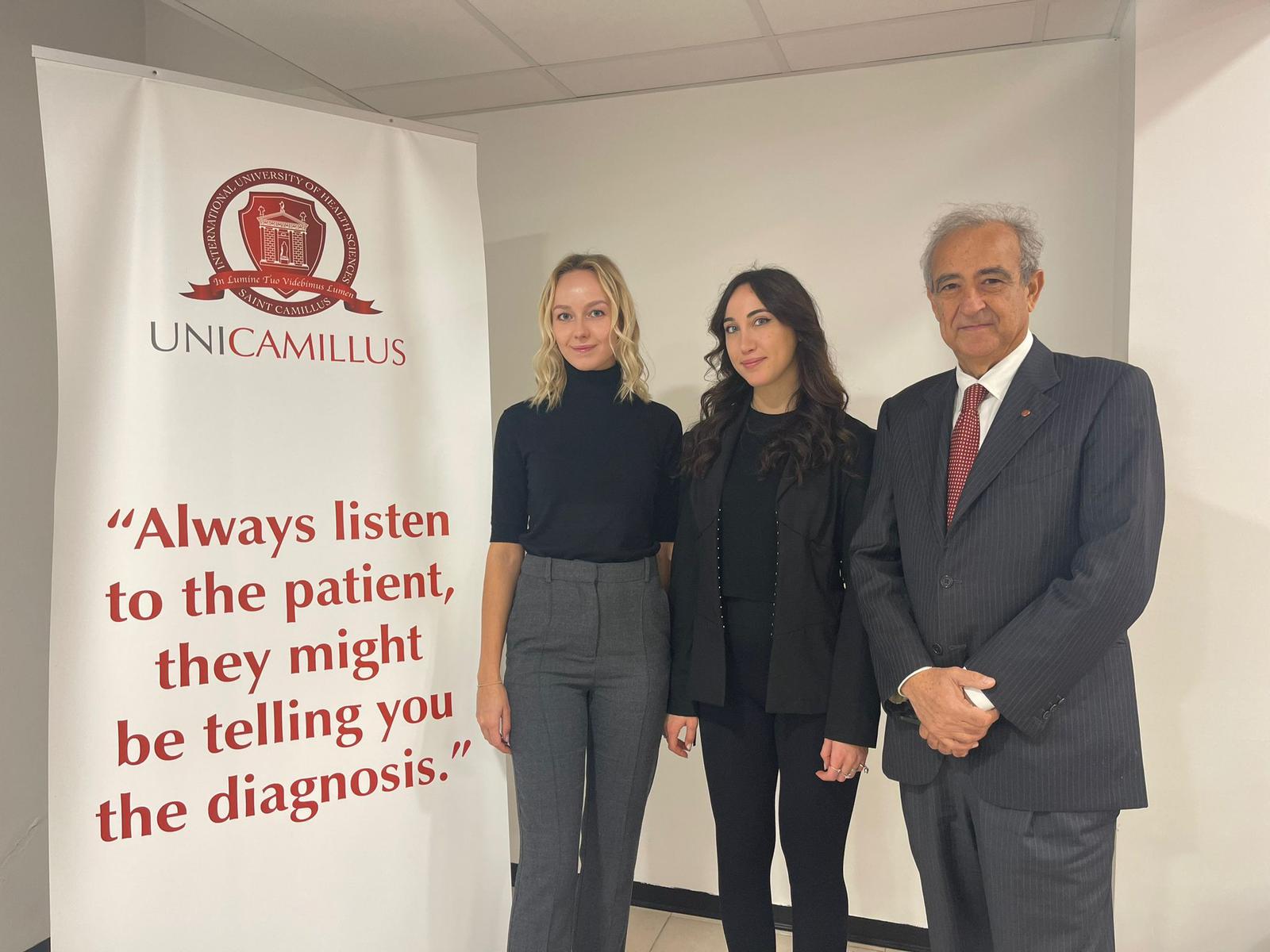
A team of international researchers and UniCamillus students has developed an interdisciplinary study combining medicine, maxillofacial surgery and military history to examine a famous episode in the life of Admiral Horatio Nelson.
The aim of the study was to investigate the consequences of a facial trauma Nelson sustained during the Battle of Calvi in 1794, when fragments of stone caused a severe injury to his right eye, ultimately leading to blindness.
This episode has also been associated with the later Battle of Copenhagen, during which Nelson was ordered to withdraw while engaged in naval combat. Although the signal had been clearly transmitted, he raised his telescope to his right eye—already blind from the previous injury—and declared that he “could see no signal”. This symbolic gesture enabled him to justify disregarding the order and continuing the attack, contributing decisively to the British victory.
This episode also gave rise to the well-known English expression ‘to turn a blind eye’, meaning to deliberately ignore something—a phrase that entered common usage precisely thanks to Nelson’s actions.
The UniCamillus study, entitled “Could a Maxillofacial Surgeon Have Changed the Course of European History?”, focused on the analysis of three facial casts of the admiral made between 1798 and 1800, comparing them with historical documentation from the Battle of Calvi and with modern knowledge of zygomatic complex fractures and traumatic optic neuropathies.
The findings suggest the likely presence of a fracture of the right zygoma associated with signs compatible with ocular damage, but also indicate that the loss of vision would not have been directly caused by the fracture itself, nor treatable through maxillofacial surgery—even according to current medical knowledge.
The investigation was carried out within the UniCamillus project “Students for Research”, designed to involve students in real scientific activities.
The study on Admiral Nelson was presented at the 27th Congress of the European Association for Cranio-Maxillo-Facial Surgery in 2024, and was conducted by Iga Mamińska and Martina Longo (UniCamillus students), Nikhil Cascone (Barts Health NHS Trust, Royal London Hospital), Haizhong Zhang (Chinese PLA General Hospital), and Professor Piero Cascone (UniCamillus Professor of Maxillofacial Surgery), who led the research.
To learn more, we spoke with Iga Mamińska, UniCamillus Medical student and one of the authors of the study.
Hi Iga! Which year are you in, and what would you like to specialise in?
“I’m in the final year of the MSc in Medicine. I’d like to specialise in a field that combines clinical and surgical practice, because I’ve always had a strong interest in surgery—especially microsurgery”.
Tell us a bit about “Students for Research”…
“Students for Research is a project created by Professor Piero Cascone with the aim of involving students in clinical and scientific research activities. It offers a real opportunity to take part in studies, collaborate with specialists, and contribute to scientific publications and conferences. It’s a highly formative experience because it allows students to approach research while still in medical school”.
What motivated you to take part in this study on Horatio Nelson?
“The idea was first proposed by Professor Cascone, who is very passionate about Horatio Nelson and his impact on European history. What immediately struck me was the interdisciplinary nature of the project, which brings together medicine, maxillofacial surgery and history”.
How did the idea of analysing Nelson’s facial casts from a medical perspective come about?
“It came from the fact that facial casts are the most faithful and objective impressions of Nelson’s features. Unlike artistic portraits, which can be influenced by the artist’s interpretation, casts allow us to observe real anatomical signs directly. In these casts, we identified several lesions compatible with facial trauma, such as flattening of the right cheek, depression of the right malar eminence and infraorbital rim, ocular dystopia in the right eye, and a downward displacement of the right eyeball”.
What were the main objectives of the study?
“The main goal was to understand whether the trauma Nelson sustained during the Battle of Calvi caused not only blindness in his right eye, but also a possible fracture of the right zygoma. We also wanted to assess whether modern maxillofacial treatment could have changed the clinical outcome”.
Which tools or methods did you use?
“We analysed the facial casts by comparing morphological parameters typical of zygomatic fractures, such as facial symmetry and the position of the eyeballs. We integrated these observations with historical sources and modern medical literature on zygomatic complex fractures”.
What was the most surprising discovery?
“The most surprising aspect was the compatibility between the signs found in the casts and a possible zygomatic fracture. However, we also found that the loss of vision probably would not have been preventable, even with modern surgical techniques”.
What does this research tell us about eighteenth-century medicine?
“It clearly shows the limitations of the time: diagnoses based solely on observation and the absence of advanced tools. Many complex injuries could easily be misunderstood or left untreated”.
How many people worked on this study? Did it take many months?
“The team included Professor Cascone, myself, another student—Martina Longo—an ophthalmologist, and an international collaborator from a Department of Stomatology in China. We worked on the project for several months, especially during data collection, analysis and literature review”.
Was there anything about Nelson’s life that surprised you while working on the study?
“Yes, I was particularly struck by both his relationship with Lady Hamilton— which was unusually intense and unconventional for the time—and his extraordinary resilience. Despite numerous illnesses and injuries, he continued to play a decisive role in European history, showing remarkable determination”.
Will there be further developments related to this study?
“Absolutely. We would like to expand the project using advanced technologies such as artificial intelligence and 3D digital reconstruction to analyse the facial injuries in even greater detail. This could allow for an even more precise understanding of the trauma and its consequences”.
Are there other historical figures you would like to study?
“Yes—for example, Henry V of England, who suffered a severe facial injury caused by an arrow. It would be fascinating to analyse his case using modern techniques”.
Do you think this experience will influence your future?
“Yes, it strengthened my interest in surgery and in the integration between clinical practice and scientific research”. “It also reinforced my passion for surgical disciplines, especially those that allow for a comprehensive approach to patient care”.