UniCamillus University confirms its position as a leading institution in the Italian academic landscape. This is highlighted by the new 2026 AlmaLaurea Reports on Study Programmes and Employment Outcomes, which portray a university capable of combining high-quality education, strong attractiveness, and concrete results in the job market.
High performance and above-average employment rates
AlmaLaurea data first of all highlight UniCamillus’ ability to train professionals who successfully and quickly enter the labour market.
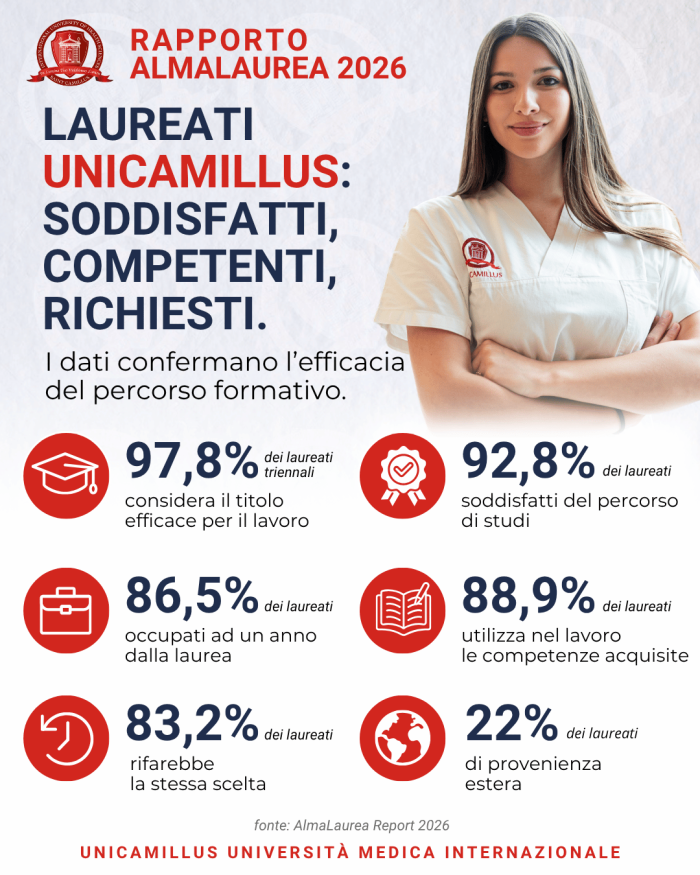
Among bachelor’s graduates employed one year after graduation, 97.8% consider their degree effective for the job they perform, compared to a national average of 60.4%. This result demonstrates the strong alignment between academic training and the skills required in professional contexts.
Also one year after graduation, the employment rate for bachelor’s degree holders reaches 86.5%, higher than the national average (UniCamillus University confirms its position as a leading institution in the Italian academic landscape. This is highlighted by the new 2026 AlmaLaurea Reports on Study Programmes and Employment Outcomes, which portray a university capable of combining high-quality education, strong attractiveness, and concrete results in the job market.
Positive results are also recorded for second-cycle graduates: one year after graduation, the employment rate reaches 86.3%, while over 80% of employed graduates report a strong coherence between their field of study and their professional activity.
High satisfaction and strong connection with the University
Looking beyond employment outcomes to the study experience itself, students also express a highly positive assessment of their university years. Overall, 92.8% of graduates report being satisfied with their academic experience, particularly with the quality of teaching, relationships with faculty members, and the organisation of study programmes.
The level of trust built with the University is further confirmed by graduates’ choices: more than eight out of ten would choose UniCamillus again. Of these, 76.9% would enrol in the same degree programme at the same university.
Strong national and international attractiveness
One of UniCamillus’ distinguishing features is its strong international vocation. International students account for 22% of graduates, a share almost four times higher than the national average (5.6%). In bachelor’s degrees in Healthcare Professions, the international presence reaches 45.9%, further confirming the University’s ability to attract students from diverse geographical and cultural backgrounds.
The University’s attractiveness is also evident at the national level: more than half of graduates (53.3%) come from regions other than Lazio, more than double the national average (23.9%).
Study regularity and quality of academic pathway
The academic pathway also shows particularly significant results. 86.4% of graduates complete their studies within the expected timeframe, compared to a national average of 60.4%. In single-cycle Master’s degrees in Medicine and Surgery and Dentistry, the proportion of students graduating on time reaches 96.2%.
These results are complemented by an average graduation grade of 104.7 out of 110, higher than the national average of 102.8.
These figures reflect a structured learning environment that effectively supports students in achieving their degree through an organised, efficient, and success-oriented academic pathway.
Rector Profita’s statement
“Behind every percentage there is a person who chose UniCamillus to build their future. The AlmaLaurea data reflect this trust and the University’s ability to turn it into real skills and opportunities,” says Gianni Profita, Rector of UniCamillus. “Training healthcare professionals means taking on a concrete responsibility towards individuals and healthcare systems. It is a commitment that requires quality, rigour, and awareness of the social role of these figures. Students’ recognition and their professional outcomes are the most authentic confirmation of the value of this work.”